Types of conveyor systems: How to choose the right one for your production line
Every production line depends on the efficient movement of materials and products. From the moment raw materials enter a facility until finished goods reach the packaging stage, each transfer must be carefully coordinated.
This is where industrial conveyor systems become essential. They reduce manual handling, connect different production stages, and help maintain a consistent workflow. But not every conveyor is suitable for every application.
Should you choose a belt conveyor, a roller system, or a more specialized solution? The answer depends on what you need to transport, how your production line operates, and the conditions within your facility.
Understanding the different types of conveyor systems is the first step toward making the right choice.
What are industrial conveyor systems, and how do they work?
Industrial conveyor systems are mechanical handling solutions designed to move materials, products, or components between different locations within a production facility.
Depending on their design, they may transport individual items, packaged goods, bulk materials or heavy industrial loads. They are widely used in food processing, manufacturing, woodworking, packaging and logistics.
Most conveyor systems consist of a supporting frame, a conveying surface and, where required, a drive mechanism. Electric motors, gearboxes, rollers, belts or chains provide the movement, while guides and control systems help manage product flow.
For example, a material handling conveyor can transfer products from a processing machine directly to a packaging station, reducing the need for manual intervention.
Beyond transportation, conveyors can also support sorting, inspection, product accumulation, and synchronization between machines. Their effectiveness, however, depends on selecting a system that matches the specific application.
Read also: Custom Engineering: Tailored engineering solutions
The main types of conveyor systems and their applications
Conveyors differ in their operating principles, load capacity, conveying surfaces, and installation requirements. Some are designed for delicate products, while others handle heavy materials or work in demanding industrial environments.
Let’s explore the most common types and where they are typically used.
Belt conveyor systems
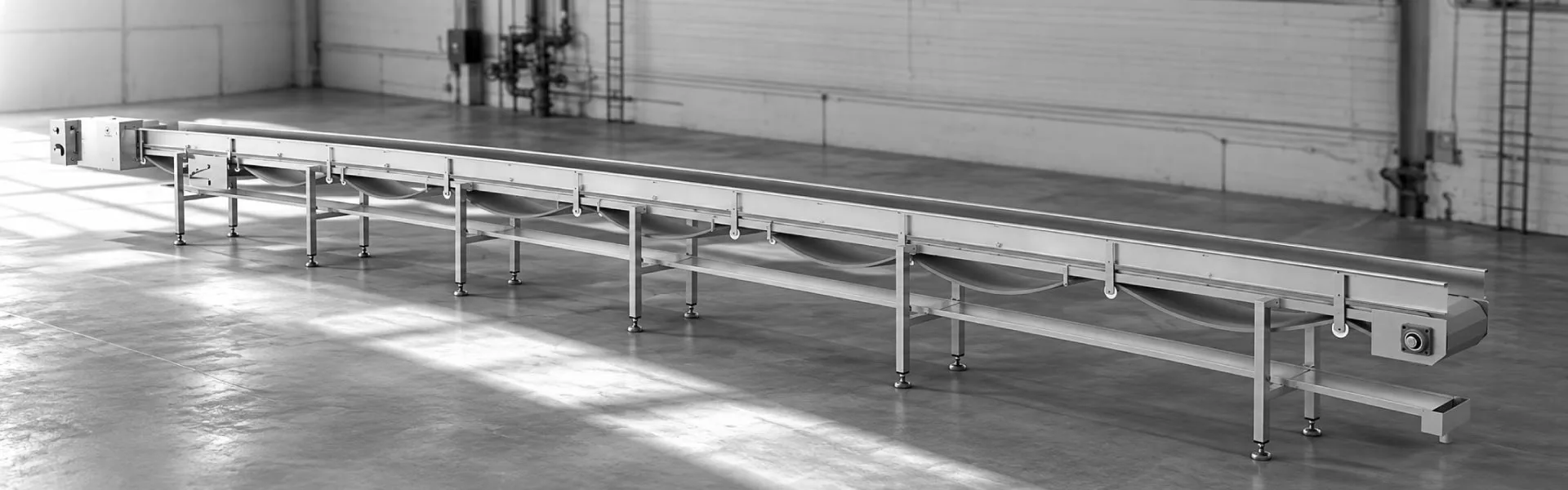
Belt conveyors are among the most widely used solutions in industrial material handling. They operate through a continuous belt moving around pulleys, driven by a motorized mechanism.
Their main advantage is the continuous supporting surface, which makes them suitable for transporting products of different shapes, sizes, and weights, provided the belt and supporting structure are correctly specified.
There are also different types of belt conveyor systems, including flat belt, modular belt, and cleated belt configurations, each serving different conveying requirements.
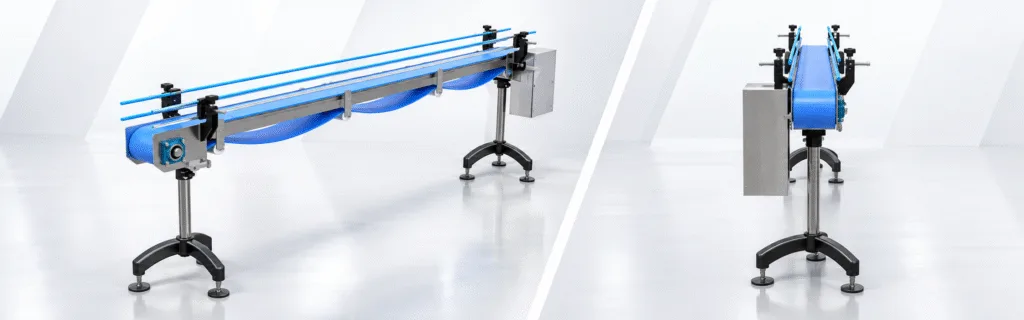
For example, Arrowhead Engineers’ FTC 03 Conveyor Belt is designed for the controlled transportation of jars, bottles, and packaged products. Its adjustable side guides help maintain product stability throughout the conveying process.
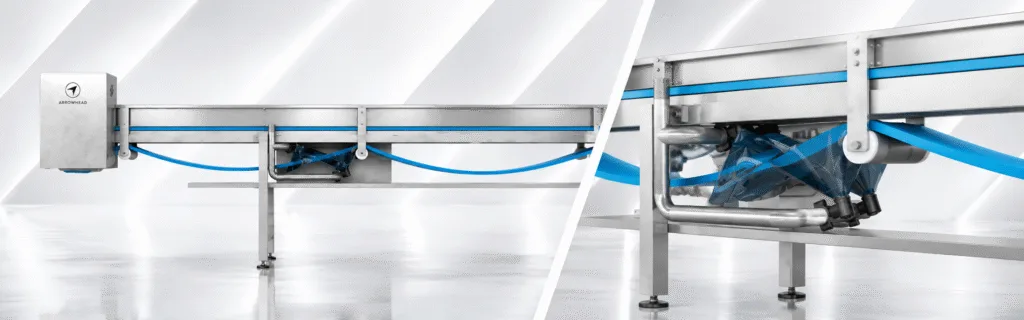
In food processing applications, hygiene requirements can influence the entire design. The FTC 18 Belt Conveyor, for instance, incorporates an automatic belt-washing system for handling products such as fruit and vegetable purées.
Belt conveyors are particularly useful when smooth movement, consistent conveying speed, and reliable product support are priorities.
Learn more: Food production lines: Design & Optimization
Roller conveyor systems
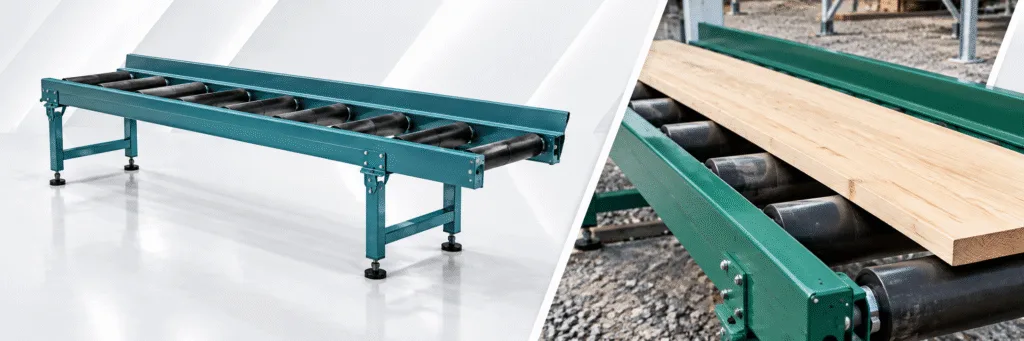
Instead of a continuous belt, roller conveyors use a series of cylindrical rollers to move products along a defined path.
They can be gravity-operated, where movement depends on a slight incline or manual assistance, or powered, where motors drive the rollers.
These systems are commonly used for transporting boxes, pallets, wooden panels, and other items with sufficiently rigid, stable surfaces.
In woodworking facilities, for example, roller conveyors help move large panels between cutting, processing, and finishing stations. Arrowhead Engineers offers solutions such as the RLR25 industrial roller conveyor, designed for the transportation of wood slabs, MDF, and other large panels.
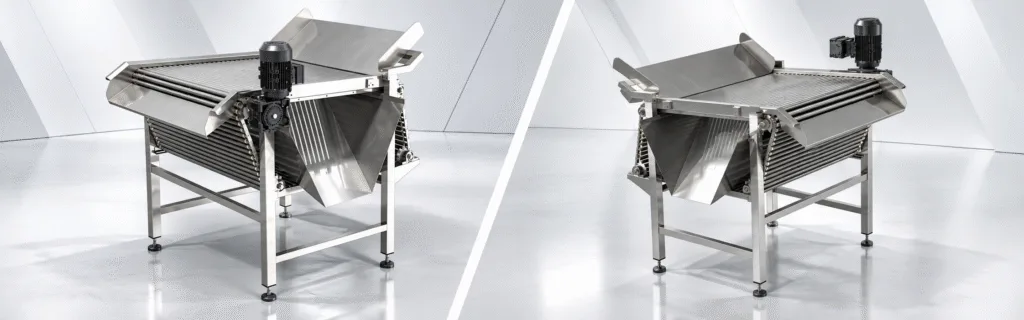
Roller systems also have specialized applications in food processing. The FRL10 Cherry Roller uses rotating rollers to transport fruit while allowing inspection of its surface during sorting.
One important consideration is product support. Small, irregularly shaped, or flexible items may require a different roller arrangement or an alternative conveying surface to prevent instability.
You may be interested in: Wood processing machinery: What a modern production facility needs
Chain and modular conveyor systems
When standard conveying surfaces cannot meet specific load or layout requirements, chain and modular systems provide additional options.
Chain conveyors use moving chains to transport products or support heavy loads. They are commonly used for pallets, industrial containers, and materials requiring a robust conveying mechanism.
Modular belt conveyors, on the other hand, feature interconnected plastic segments that form a flexible conveying surface. They can be configured for applications involving frequent cleaning, drainage, or complex production layouts.
A related solution is the plastic slat-chain conveyor, which uses articulated links to carry products along a defined path.
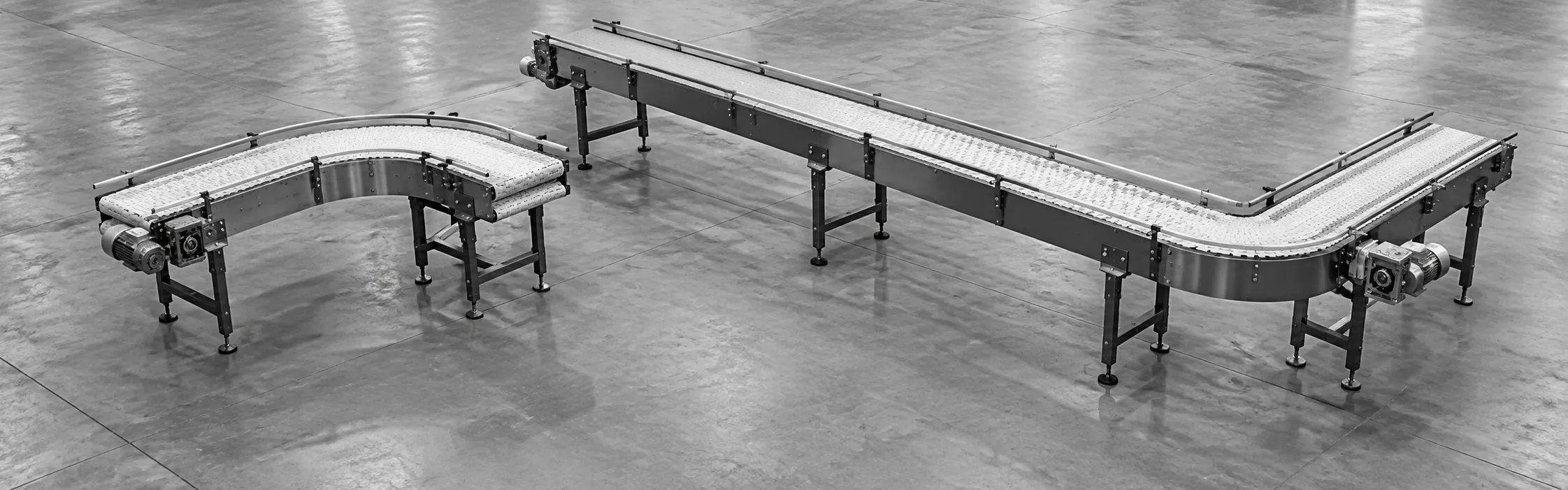
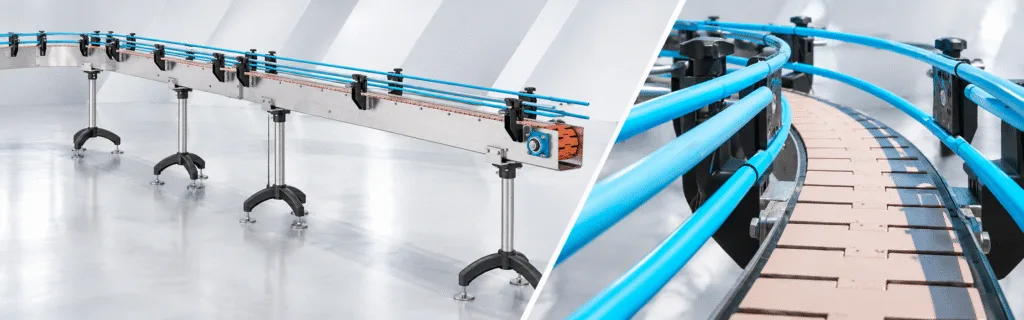
Arrowhead Engineers’ FDR 04 & 08 Conveyor Turning Belt uses a plastic slat-chain conveying surface to transfer bottles, containers, and packaged products around corners.
This configuration is particularly valuable in bottling and packaging facilities where the production line must change direction without interrupting product movement.
Inclined and vertical conveyor systems
Not every production process operates at the same height. In many facilities, products must move between different levels or reach equipment positioned above the main production floor.
Inclined conveyors typically use belts with sufficient grip, cleats, or other retaining features to prevent products from slipping during upward transportation.
Vertical conveying systems and industrial elevators serve a similar purpose but use different mechanical arrangements, often requiring less horizontal floor space.
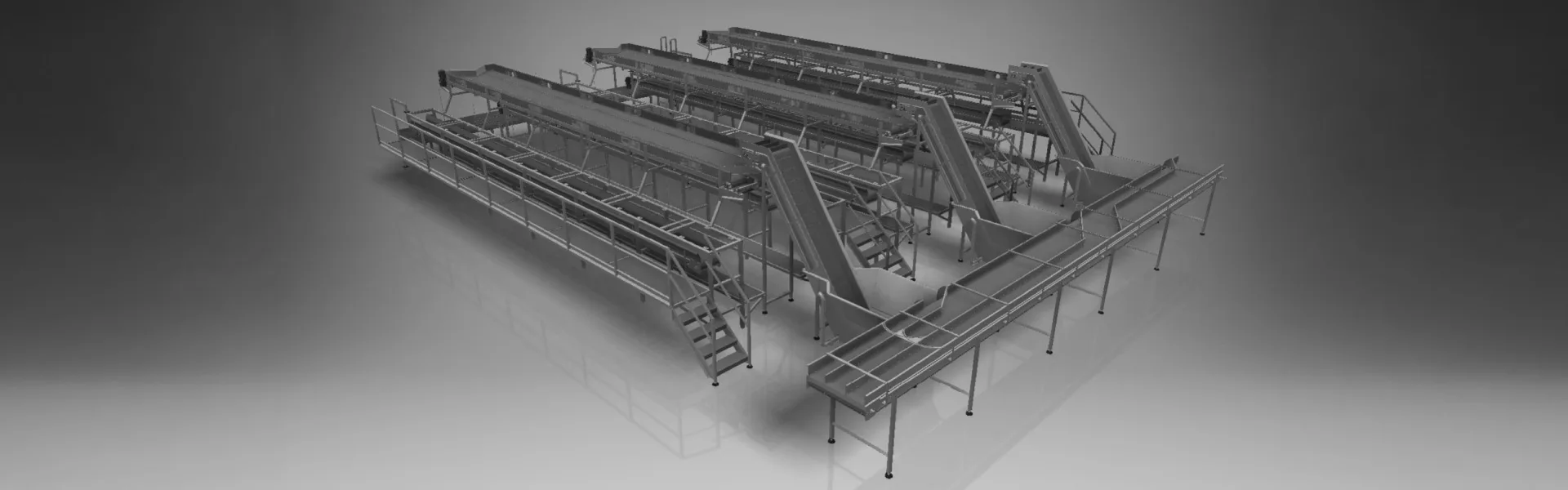
In fruit processing, for example, products may need to reach washing, sorting, or processing equipment located at a higher level.
Arrowhead Engineers develops equipment such as its Cherry Rotary Elevator, manufactured according to the dimensional requirements of each installation.
The appropriate solution depends on the height difference, product characteristics, available space and the loading and discharge conditions.
Roller conveyor vs belt conveyor: What are the key differences?
Among the available options, the roller conveyor vs belt conveyor comparison is particularly important when selecting equipment for a production line.
Both systems transport products efficiently, but their operating characteristics make them suitable for different applications.
A belt conveyor provides a continuous surface, making it particularly useful for smaller items, irregularly shaped products, or materials requiring stable support throughout transportation.
A roller conveyor, by contrast, supports products through multiple contact points. It is often preferred for rigid loads, boxes, pallets and large panels, especially where simple loading, unloading or accumulation is required.
Maintenance requirements also differ. Belt conveyors need appropriate belt tracking, tensioning, and surface inspection, while roller systems require regular checks of rollers, bearings, and drive components.
So, how can you determine which option is more suitable?
Before making a decision, evaluate the following factors:
- Product characteristics: Consider weight, dimensions, shape, stability, and sensitivity to mechanical contact.
- Production capacity: Determine the required throughput, conveying speed, and potential accumulation needs.
- Facility layout: Examine available floor space, transfer heights, corners, and connections with existing machinery.
- Operating conditions: Account for moisture, temperature, dust, cleaning procedures, and hygiene requirements.
- Maintenance and integration: Consider accessibility, component replacement, safety, and compatibility with existing automation.
These factors are fundamental to effective conveyor system design. The goal is not simply to move products from one point to another, but to create a reliable flow that supports the entire production process.
Read also: Food processing machinery: How to choose the right equipment and what to consider
Custom conveyor solutions by Arrowhead Engineers
Every industrial facility has different production requirements. A conveyor designed for handling glass jars will not necessarily meet the demands of transporting wooden panels or processing fresh fruit.
That is why selecting the appropriate system often requires more than comparing standard equipment specifications.
At Arrowhead Engineers, we approach conveyor design by examining the actual needs of each application, from product characteristics and production capacity to installation constraints and integration with existing machinery.
Our experience includes belt conveyors, roller systems, specialized conveying equipment and complete material handling solutions for the food and wood processing industries.
Through engineering studies, mechanical design, and manufacturing, we develop solutions that support efficient material flow, reliable operation, and the long-term requirements of each facility.
Whether you are developing a new production line or improving an existing installation, choosing the right conveyor starts with understanding your process.
MORE ARTICLES
Custom Engineering: Tailored engineering solutions
Food production lines: Design & Optimization